
News
Erasmus Is Back: What the UK Rejoining Means for Students and Graduates
After six years away, the UK rejoins the EU's Erasmus+ programme in 2027. Here's who can take part, how the money works, what happens to the Turing Scheme, and how to give yourself the best chance of a place.

Introduction
For more than 30 years, Erasmus was one of the best-known parts of British university life: a year in Barcelona, a semester in Berlin, a placement in Lyon. Then, after Brexit, it stopped. The UK left the programme, and the Turing Scheme took its place.
Now Erasmus+ is coming back. But what does that actually mean if you're a student, an apprentice or a recent graduate? Who can go, who pays, and when can you apply?
We went through the government's announcements, the official guidance for universities and the EU's own rules to find out. Most of it is good news, and some of it is still being worked out. Here's everything you need to know.
Erasmus Is Officially Returning in 2027
In December 2025, the UK and the EU agreed that the UK would rejoin Erasmus+, the EU's programme for education, training, youth and sport. The legal agreement was signed in April 2026, and the UK takes part again from 2027, with the first trips abroad in the 2027/28 academic year.
From deal to departure
The key dates for Erasmus+ in the UK
- Dec 2025
Deal agreed
- Mar 2026
Charter deadline
- Apr 2026
Deal signed
- Sep 2026
Turing's final year
- Nov 2026
Funding round opens
- 2027
UK rejoins
- Autumn 2027
First students travel
- 2028 onwards
Still to be decided
- £570m
- What the UK pays for the first year, after a 30% discount on the usual terms
- 100,000+
- People expected to benefit in the first year alone
- 2027/28
- The academic year the first students travel
The British Council will run the programme in the UK, as it did from 2014 to 2020. Over those six years, it awarded around £1 billion to UK organisations and worked with more than 580,000 participants.
Who Gets to Go? It's Not Just University Students
Erasmus+ isn't just for university students. It covers school pupils, further education students, apprentices, university students and staff, adult learners, youth workers and sports professionals.
For university students, there are three main options:
- Study abroadSpend between two and twelve months at a partner university in Europe.
- A traineeshipWork in a relevant workplace abroad for two to twelve months, ideally as part of your course.
- A short programme"Blended" programmes mix online learning with five to 30 days abroad.
Apprentices and further education students can do work placements with European companies. As for where you can go, Erasmus+ covers 33 countries: the 27 EU countries, plus Iceland, Liechtenstein, North Macedonia, Norway, Serbia and Türkiye. Switzerland is due to join alongside the UK in 2027, once its parliament approves the funding.
Where Erasmus+ can take you
The countries taking part from 2027
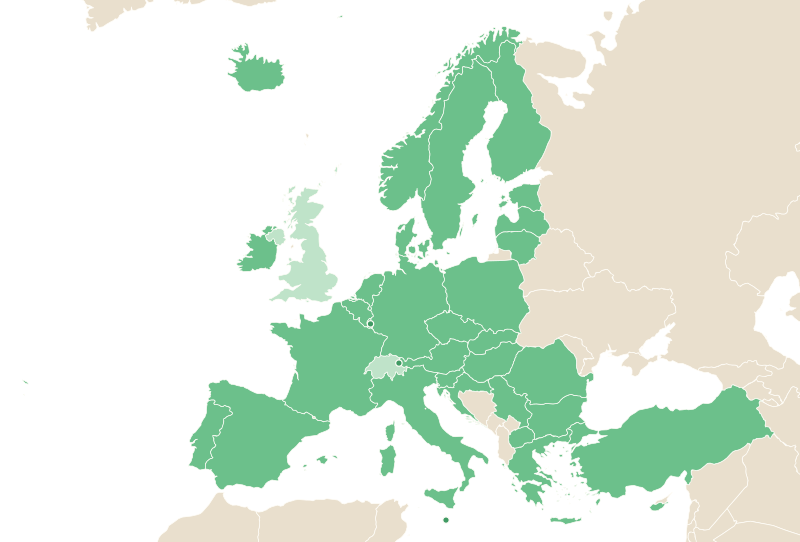
- Taking part
- Joining in 2027: the UK and Switzerland
Already Graduating? You Might Still Be Eligible
Interestingly, you don't have to be a student when you go. Under Erasmus+ rules, recent graduates can do a traineeship abroad, as long as it happens within one year of graduating.
The catch is that you usually have to be selected by your university while you're still studying, often during your final year. So if you're a finalist now, it's worth asking about this before you graduate, not after.
How to apply?
Not directly: students can't apply to Erasmus+ themselves. Your university, college, school or employer applies for the funding, then runs its own selection process.
Institutions can bid for funding from November 2026, so the opportunities you'll see advertised next year depend on what your university applies for now.
The Best Part: What Will It Actually Cost You?
This is where Erasmus+ gets really appealing.
- No fees at the host universityErasmus students don't pay tuition to the university they visit.
- Lower fees at homeIn England, universities can charge at most 15% of the usual fee for a full year abroad. At Leeds, for example, that's £1,465 instead of £9,790 in 2026/27.
- A grant towards your costsErasmus+ funding is designed to help with travel, accommodation and living costs.
- Extra support if you need itStudents from disadvantaged backgrounds can get extra funding.
There's one thing we can't tell you yet: how much the grants will be. The rates for 2027 depend on the EU's programme guide for that year, which hadn't been published when we wrote this.
What Happens to the Turing Scheme?
The Turing Scheme was the UK's replacement for Erasmus, launched in 2021, and it's now closing. 2026/27 is its final year, with a budget of £78 million, down from £110 million at launch. It won't run in 2027/28.
Turing did some things well. It funded more than 200,000 UK students to study, work and volunteer abroad, and unlike Erasmus+, it covered the whole world, not mainly Europe. It also focused on students from groups that had rarely taken part before.
Some academics worry that those strengths could be lost. Erasmus+ does fund some placements beyond Europe, but it's mainly a European programme. Wales is also losing its own scheme, Taith, whose 2026 funding call is the last one.
If you were hoping to use Turing next year, talk to your university soon. This is the last chance.
What We Still Don't Know
There are still a few unanswered questions.
- What happens after 2027/28?The current deal only covers the first year. The UK's place beyond that has to be negotiated alongside the EU's next long-term budget.
- How much will the grants be?As above, the 2027 rates haven't been published yet.
- What about visas?The UK has already made it easier for EU participants to come here: from October 2026, most can come for up to six months on an Electronic Travel Authorisation or visitor visa. For UK students going the other way, it depends on the country. Short stays in the Schengen area are usually visa-free, but longer placements often need a national visa.
- Which universities take part?Each university needs an Erasmus charter and has to apply for funding itself, so check that yours is taking part.
Why a Year Abroad Could Give Your Career a Head Start
A year abroad isn't just a good story for the pub, although it is that. Students who study or work abroad often come back with exactly the things graduate employers say they want: independence, adaptability, confidence and, sometimes, a second language.
There's some evidence that it pays off. A 2025 Universities UK International report found that students from less advantaged backgrounds who studied abroad went on to a professional-level employment rate of 70.2%, compared with 68.3% for similar students who didn't.
It's not a huge gap. But in a graduate job market where employers receive an average of 140 applications per vacancy, small advantages add up. A traineeship in Amsterdam or Madrid gives you something to talk about that most other applicants don't have.
For some perspective, here's how time abroad compares with two other ways students get ahead: further study and a placement year.
Extra experience, better jobs
Share in professional or graduate-level work. Each pair comes from a different study, so compare within a pair.
The pattern is the same each time: extra experience goes hand in hand with better jobs. These figures show a link, not proof, since students who choose a master's, a placement or a year abroad may already be more likely to do well. But all three give you something most applicants don't have.
Want a Place? Here's How to Get Ahead of the Competition
Places will be competitive, especially in the first year. Here are four things worth doing.
1. Talk to your university's international office now.
Ask whether your university is applying for Erasmus+ funding, which partner universities it's likely to work with, and whether it will offer traineeships or recent graduate placements. The earlier you ask, the more options you'll have.
2. Keep track of every deadline.
Erasmus+ places usually come with internal university deadlines, and they can arrive months before the official ones. Miss one, and you may have to wait a year. If you're also applying for internships, placements or graduate jobs, those deadlines can pile up quickly.
It's also one reason we built Jobstead.
Jobstead is a free application tracker for students and graduates. It keeps your applications, deadlines, outreach and feedback in one place, so an Erasmus+ application sits right alongside everything else you're applying for. And every application you log grows your own little garden, so you can see your effort adding up.
3. Think about where you want to go, and why.
Selection panels like a clear reason. Maybe it's a language you want to improve, an industry that's strong in a particular city, or a course that complements your degree.
"I've always wanted to live in Spain" is fine. "I want to work in renewable energy, and Denmark leads the field" is better.
4. Look beyond the classic year abroad.
If a full year doesn't suit you, because of money, caring responsibilities or your course, look at the shorter options. Blended programmes and short placements can give you some of the experience without the same commitment.
Europe Is Opening Its Doors. Are You Ready?
For six years, studying or working in Europe has been harder and more expensive for UK students than it used to be. From 2027, that changes.
There's still plenty to be confirmed, from grant rates to what happens after the first year. But for students, apprentices and recent graduates, the door to Europe is opening again. The people who get through it first will be the ones who ask early, plan ahead and don't miss the deadlines.
Your degree happens in one place. Your education doesn’t have to.
Sources
13 sources
- UK Government, Young people from all backgrounds to get opportunity to study abroad as UK-EU deal unlocks Erasmus+ (17 December 2025): the £570 million cost, the 30% discount, 100,000+ participants, who can take part, and the Universities UK International employment figures for students from less advantaged backgrounds (a five-year average).
- UK Government, Erasmus+ programme guidance for higher education (updated 1 June 2026): study and traineeship lengths, blended programmes, the 24 March 2026 charter deadline, applying through your provider and the November 2026 funding round.
- Department for Education, Erasmus+: what you need to know (May 2026): what the funding covers and extra support for disadvantaged students.
- European Commission, Erasmus+ opportunities for trainees and recent graduates: the one-year rule for recent graduates. The requirement to be selected while still studying comes from university guidance and varies by institution.
- Times Higher Education, British Council to run Erasmus+ as UK and EU formalise deal to rejoin in 2027 (15 April 2026) and UK to close Turing exchange scheme when it rejoins Erasmus+ (18 June 2026).
- The PIE News, Erasmus+ to replace Turing and Taith.
- ICEF Monitor, UK eases entry rules for Erasmus+ participants (September 2026).
- University of Leeds, Tuition fees and student finance: what's changing: the year-abroad fee example.
- Institute of Student Employers, Student Recruitment Survey 2025: 140 applications per graduate vacancy.
- Map: European Commission, Erasmus+ list of participating countries (the EU member states and the six associated countries), and the Finnish National Agency for Education, UK and Switzerland joining Erasmus+ (associating from 1 January 2027). Country outlines from Natural Earth.
- Chart, further study: Department for Education, Graduate labour market statistics, 2024. High-skilled employment rates for working-age (16 to 64) postgraduates (a master's or PhD as their highest qualification) and graduates (a bachelor's degree).
- Chart, work experience: TASO, Briefing note on sandwich courses (August 2022), reporting Eade (2019): the share of Nottingham Trent University placement and non-placement students who secured a graduate-level outcome. It's one university's data, and placement students may differ from others in other ways.
- Chart, time abroad: Universities UK International, Gone international: a new generation (April 2025), as quoted by the UK Government above.